
Designing
AI Quality Systems
Part 3:
Cross-Regional AIGC Demo. From Framework to Applied Concept
December 18, 2025 · Kenneth Hung · 20 min read
User's problem: "I want to sell these sneakers across three different regions (APAC, US/EU, and LATAM) to grow GMV. But I don't know how to create video content that fits each region's aesthetic and drives sales."
The solution: A concept design for AIGC Studio, a mobile-first AI video generation tool for TikTok Shop. A built-in AI Creative Director suggests target audiences, creative direction, and creative briefs per region, based on top-performing patterns per market. The AI quality framework from Part 2 runs invisibly across the seller's five-step flow. Includes an interactive prototype you can test live.
Grounded in human-in-the-loop design, the work spans AI Behavior Design, product and UX architecture for AI-native tools, cross-cultural content design, design system discipline, and an honest documentation of where current AIGC technology actually lands.
-
Part 1 introduced the Floor / Ceiling / Style framework.
Part 2 covered how that framework scales across verticals, markets, and execution, and introduced AI Behavior Design as a practice.
Part 3 (this piece) puts the framework into practice for the cross-regional adaptation use case: one product, three markets, one quality system.
Part 4 applies the same framework to a different use case: making AI-generated content feel like authentic human creation.
-
The seller's problem:
"I want to sell these sneakers across three different regions (APAC, US/EU, and LATAM) to grow GMV. But I don't know how to create video content that fits each region's aesthetic and drives sales."
The Solution
An AIGC Studio in the seller's pocket, with a built-in AI Creative Director that turns one product upload into regionally tuned commerce videos.
A five-step seller flow runs above an eight-step AI quality framework: the seller uploads a product, selects markets, reviews AI-generated creative direction, approves the creative brief, and previews generated videos before publishing.
Behind that experience, the Floor / Style / Ceiling framework runs two background validation passes, generates specific creative outputs based on the top-performing creative patterns per market, and surfaces credit-cost transparency at every commit point. The system produces three regionally tuned commerce videos like the samples below.
Try the interactive prototype. Tap through any step to see how the framework's hidden layers shape the seller's decisions.
Asia Pacific
(APAC)
US & Europe
(US/EU)
Latin America
(LATAM)
Production disclosure
These regional video demos were created in December 2025 over three days, using Dreamina, Runway Gen-4.5, Google Flow / VEO 3.1 / Nano Banana Pro, and CapCut. AIGC tooling moves fast, and what was rough in December 2025 may already be improved.
The demos are deliberately not refined as polished commercials. They surface where current AIGC video generation runs into technical limits: visual consistency drift, text hallucination, audio-video sync, and pixelation and temporal stability.
Read more about these in the "Challenges and Solutions" section below.
User Flow:
The Seller's Journey
This user journey is exploratory. It applies the Floor / Style / Ceiling framework from Part 2 to a concrete product context, modeling how the seller experience, the AI quality framework, and the regional differentiation could work together as a coherent system.
What it doesn't model: technical feasibility, ML implementation details, product strategy, or business viability. The design thinking and system architecture are here; engineering, ML, and PM validation aren't.
How a seller generates a TikTok Shop video
Eight steps where the seller decides, the system checks, and the Floor / Ceiling / Style framework runs in the background. Hover the legend below to see which layers apply at each step.
- Product URL or assets
- Character / model refs
- Video and voice refs
- Image resolution
- Brand mark clarity
- Product visibility
- APAC 16-30
- US/EU 20-40
- LATAM 18-35
- Content format
- Visual aesthetic
- Color scheme
- Review prompts
- Edit any field
- Generate
- Ceiling score
- Style match %
- Confidence rating
- Generated content safety
- Brand mark integrity
- Regional compliance
- Preview video
- Iterate or refine
- Publish, schedule, or save
Dashed branches show recovery paths. The seller can return to earlier steps at any decision moment — the system is iterative, not one-shot. The ×3 badges indicate that step produces region-specific output (one per selected market).
Most recovery paths loop back inside the AIGC Studio. The exception is Step 8's platform-rejection branch (↗) — when TikTok's own moderation rejects a video after submission, the seller must address TikTok's feedback before resubmitting. This is platform-level moderation, separate from the AIGC Studio's internal Floor checks.
The flow below mirrors the user flow diagram architecture: eight conceptual stages, five of them seller-facing, two invisible background validations, one final commit. Each step calls out which framework layers (Floor / Ceiling / Style) it engages with.
-
These principles share one goal: build trust between the seller and the AI. In commerce, real money and brand reputation are at stake. Sellers can't audit AI-generated creative output frame by frame, so the system has to be honest about what it inferred, what it costs, and where the seller retains control. Human-in-the-loop is the architecture, not a feature.
The six principles below surface across the steps that follow. Each step calls out which ones it engages.
Provenance is visible. Every AI-generated output is tagged with what kind of inference it represents (AI-POWERED, AI SUGGESTED, AI CURATED, AI PREDICTED).
Cost transparency at selection, not at commit. Sellers see what they're spending before they spend it, not as a surprise at the CTA.
Fail early, fail cheap. Floor validation runs at both input and output, catching issues before expensive compute commits.
The AI suggests, the seller decides. Every AI-generated default is overridable. No final answers, only starting points.
Honest framing of predictions vs. measurements. Predicted scores are labeled as predicted, never presented as facts.
Color discipline for commit actions. Only truly irreversible, high-cost actions wear the system's primary commit color (TikTok red). Everything else is secondary.
Step 1: Seller Uploads the Product
Framework layers: All three layers begin gathering signals here.
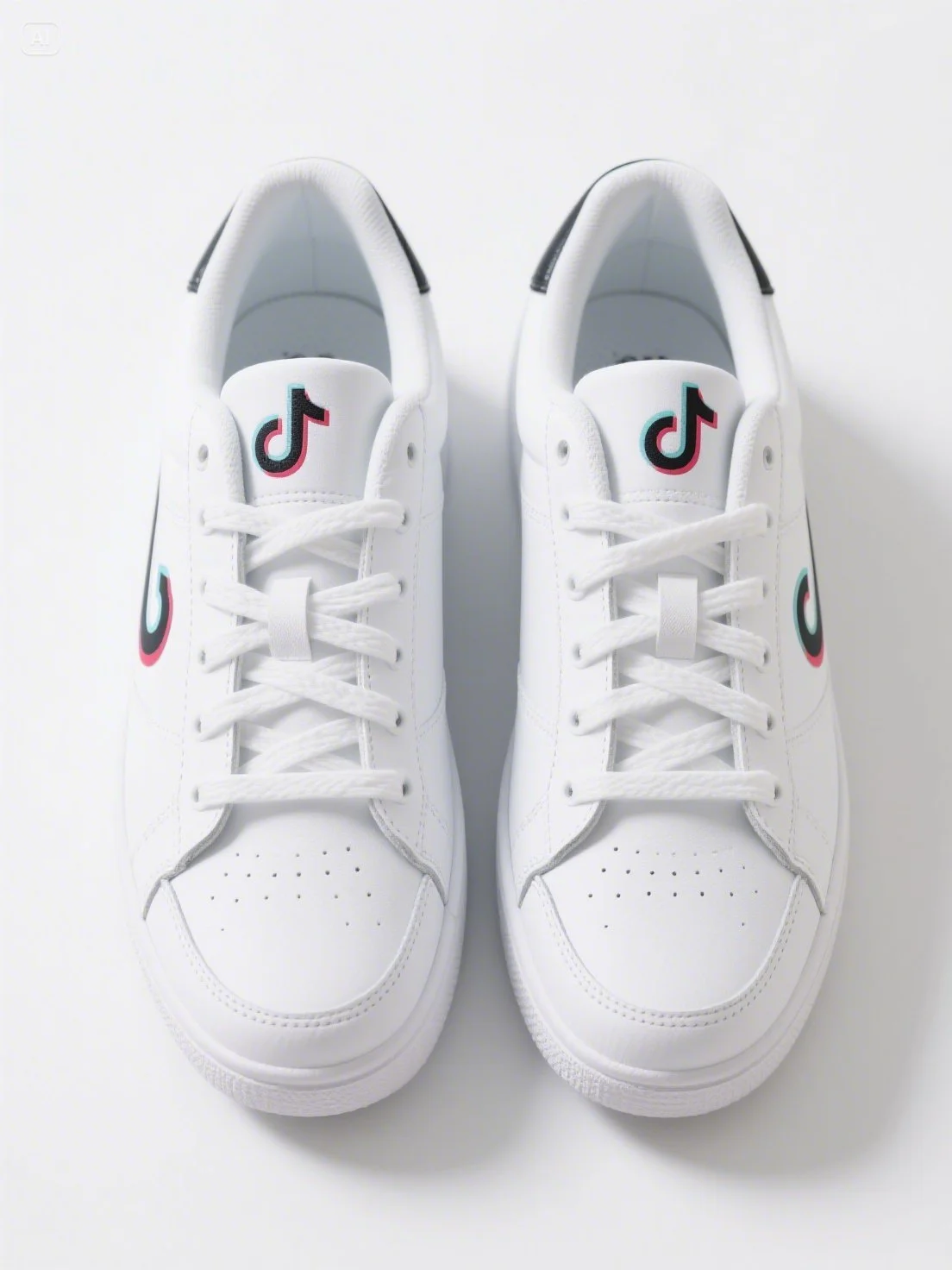
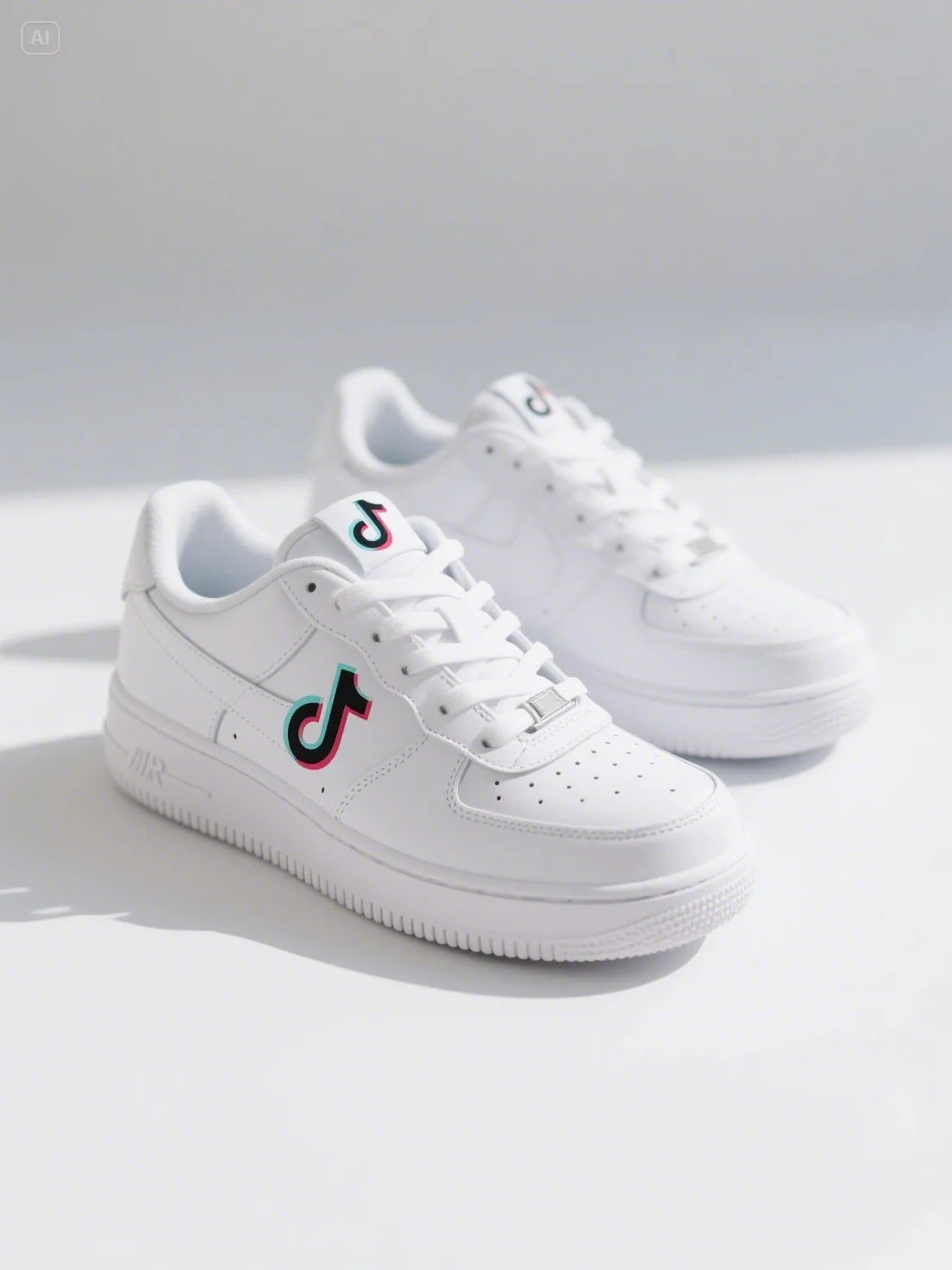
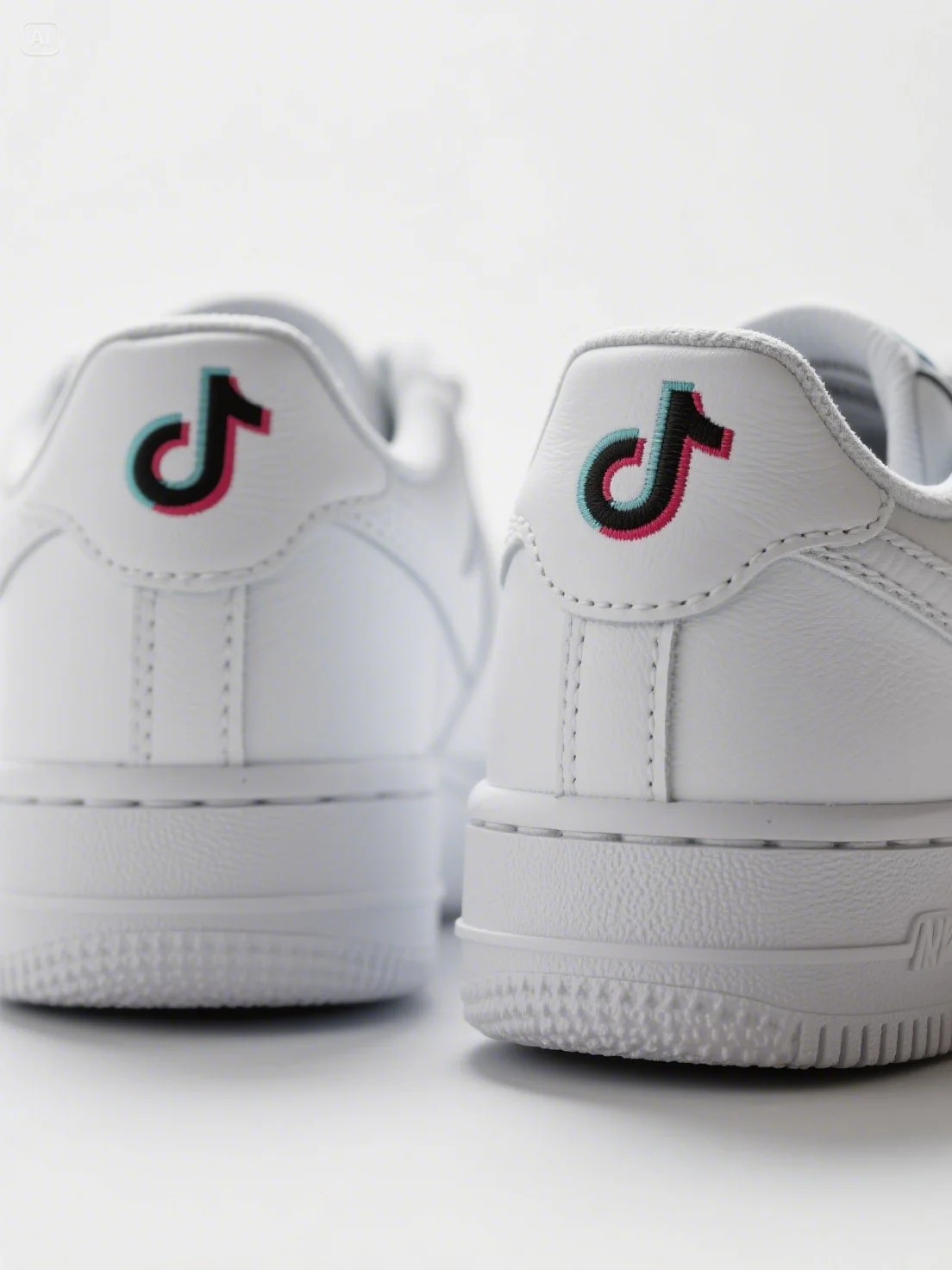
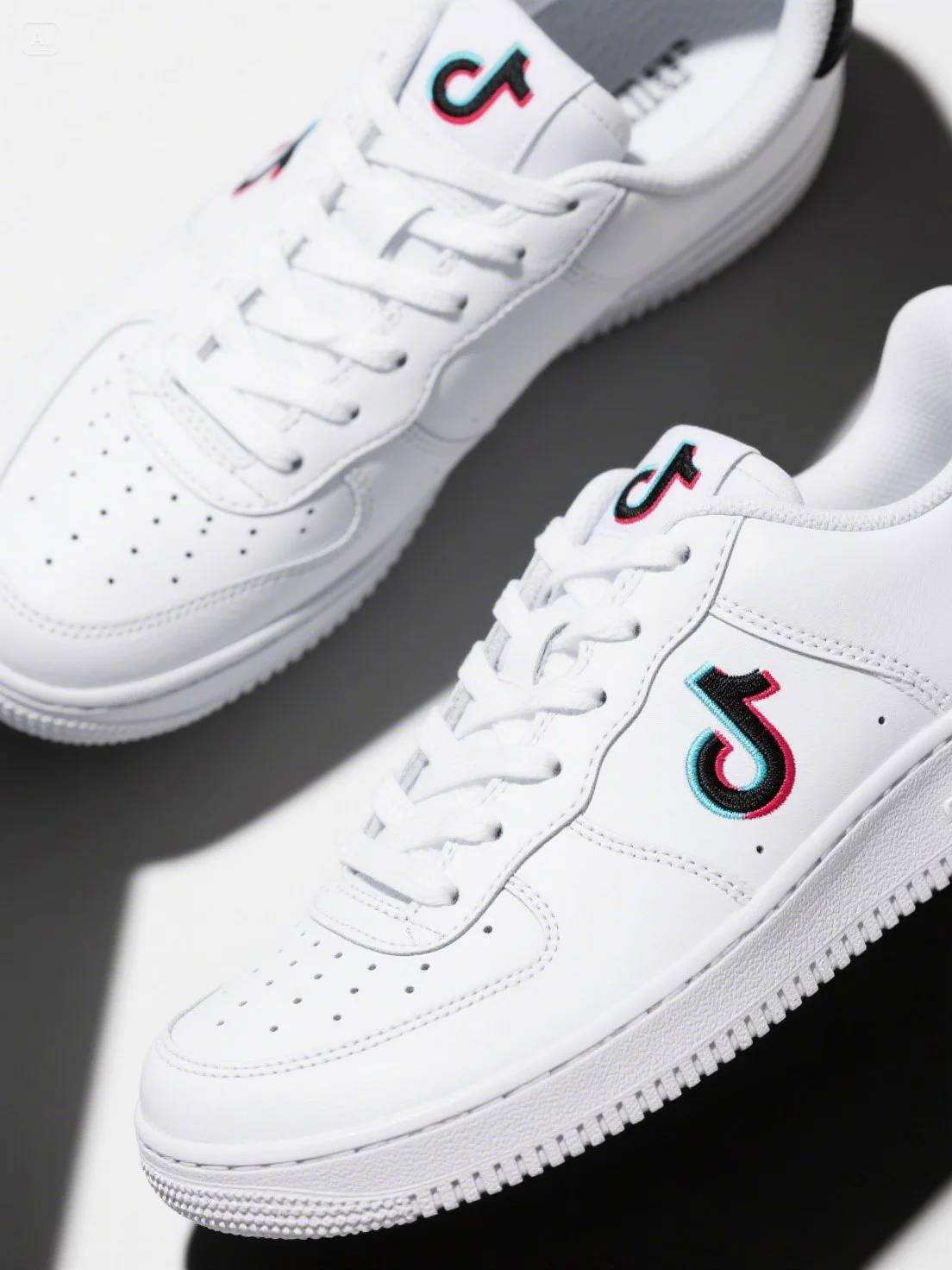
The seller logs into the TikTok Shop AIGC tool and uploads source assets across four input categories (Product Assets, Character / Person, Video Reference, Voice / Audio).
A Quick Import URL field can also extract product info directly from a webpage using AI. After upload, the system surfaces what it detected back to the seller, establishing the provenance pattern from the very first screen.
-
Product Assets — Photos, 360 spins, packaging shots
Character / Person — Real models, the seller's face, or AI avatars
Video Reference — Clips the AI should match in motion and style
Voice / Audio — The seller's voice, brand sounds, or music to match the energy
-
Product images: Four high-resolution sneaker photos (front 45-degree angle, side profile, leather detail close-up).
Product description: "A white leather sneaker that honors the classic basketball silhouette. Premium full-grain leather upper paired with the iconic high-top design and air cushion midsole. Combines retro sneaker aesthetics with modern street style."
-
Style: Classic basketball silhouette, retro sneaker aesthetics
Upper design: Premium full-grain leather, perforated for breathability
Colorway: Triple White
Midsole: Visible air cushion unit, classic curved outsole
Specs: Unisex, sizes 36 to 46
Price: Mid-to-premium positioning ($150 to $220)
-
"A classic silhouette born on the court, reborn on the street. Pure white leather carries the unbroken culture of basketball footwear. Each pair is a contemporary interpretation of a legend."
AI system response
Product upload successful. Extracting visual attributes...
Detected: full-grain leather, pure white colorway, low-top silhouette, perforated details, air cushion midsole, classic sneaker positioning.
Step 2: Upload Check (Background)
Framework layers: Floor (input-side validation).
The seller doesn't see this step. The moment upload completes, the system validates that source material meets minimum technical and policy requirements before spending compute on creative direction generation.
Catching issues here is cheaper than catching them after video generation. If a check fails, the seller sees a specific error with an actionable repair suggestion; otherwise they proceed directly to Step 3.
Floor check coverage
| Check | What it validates |
|---|---|
| Image resolution | Meets minimum 1920×1080 requirement |
| Product visibility | Product clearly visible, no occlusion |
| Brand mark | Logo readable and unobstructed |
| Text clarity | Product name and copy legible |
| Asset format | Files in supported formats, no corruption |
| Source compliance | No prohibited or restricted source material |
AI system response (only visible on failure)
One or more uploads need adjustment before we can continue. We've highlighted what to fix below.
Step 3: Seller Selects Target Regions & Audiences
Framework layers: Ceiling (benchmark targets) and Style (regional aesthetic) selection.
The seller selects target markets. Each region card shows the seller a per-region credit cost, and a running total appears as they make selections right before the CTA button.
The system pre-fills audience targeting for each selected region as AI-suggested defaults. These suggestions are inferred from patterns across hundreds of similar campaigns in each market based on platform's data. The seller can edit any field before continuing.
-
Selected regions (demo scenario)
✅ APAC (China, Korea, Japan, Southeast Asia)
✅ US and Europe (United States, Europe)
✅ LATAM (Mexico, Brazil, Colombia)
Running total: 🪙 75 (3 markets × 🪙 25)
-
The system pre-fills audience targeting for each selected region as AI-suggested defaults — sellers don't have to start from scratch. These suggestions are inferred from patterns across hundreds of similar campaigns in each market, surfaced with provenance (an AI SUGGESTED pill, a confidence rating, and a basis count). The seller can edit any field before continuing.
APAC — Primary audience: sneaker collectors, trend enthusiasts, students. Age 16-30. Style preferences: classic reissues, minimalist design, versatile styling. Confidence: High (47 similar campaigns).
US/EU — Primary audience: sneaker culture enthusiasts, urban commuters. Age 20-40. Style preferences: OG classics, individual expression, original quality. Confidence: High (62 similar campaigns).
LATAM — Primary audience: basketball fans, street style, social trendsetters. Age 18-35. Style preferences: player signatures, status display, street energy. Confidence: Medium (23 similar campaigns).
LATAM is flagged Medium confidence because the basis set is smaller — the system surfaces this honestly rather than treating all three regions as equally well-supported. The seller knows where the AI is confident and where it's guessing.
AI system response
Market configuration complete. Loading regional aesthetic preferences and benchmark data...
Step 4: Seller Reviews Regional Creative Directions
Framework layers: Style (regional aesthetic patterns) and Ceiling (per-region benchmark targets).
The system generates a creative direction for each selected region, synthesized from the top 5% GMV-converting content in that region. Each direction includes a name, tagline, vibe, aesthetic system, and core narrative.
AI-generated patterns are labeled with provenance pills (AI SUGGESTED at the direction level, AI CURATED at the aesthetic level) so sellers know these patterns came from existing top-converting content, not invention. The seller can review each, regenerate any individual region's direction (🪙 25 per region), or proceed.
-
Confirm direction
Costs: Free
What it does: Advances to Step 5
Regenerate one region
Costs: 🪙 25
What it does: Replaces that region's direction with a new generation
Edit aesthetic details
Costs: Free
What it does: Inline expand to adjust color, lighting, pacing, etc.
AI system response
Three regional creative directions generated. Synthesized from top GMV-converting content patterns in each market.
Confidence reflects how much regional data the system has to draw from. Where confidence is lower, sellers should expect more iteration. Review each direction and confirm to proceed, or regenerate any single region.
-
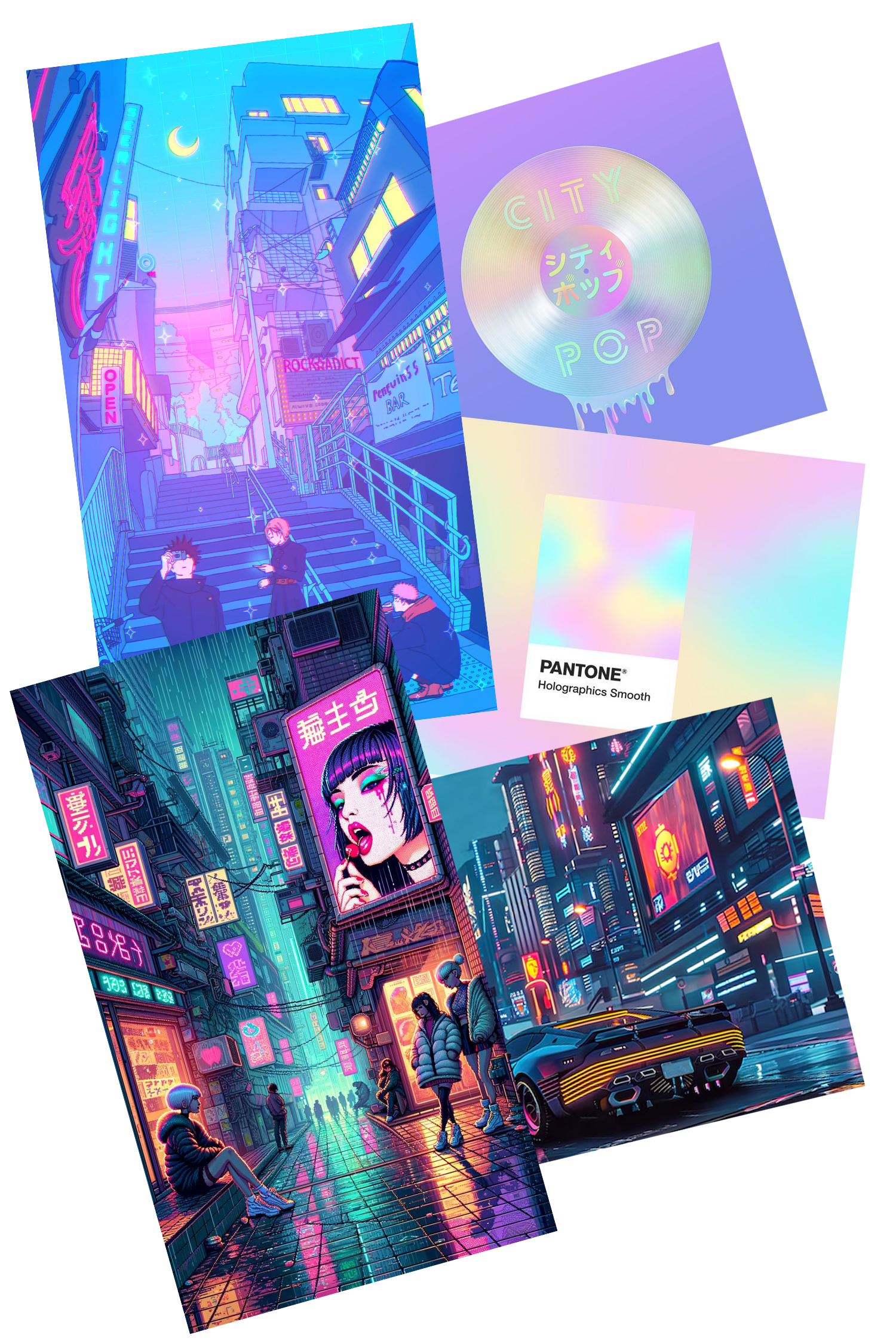
APAC
Title: Neon Bloom
Tagline: "Unlock your future self."
Overall vibe: Refined, futuristic, tech-forward, trend-savvy
Keywords: Digital identity, virtual worlds, anime aesthetics
Aesthetic system:
Color: Neon pastels, ice blue, soft pink, cyber violet
Lighting: Clean, luminous, LED, holographic
Pacing: Fast cuts, strong beats, electronic feel
Visual language: Anime, AR interfaces, digital UI
Effects: Morphing, holographic, particles, glitch
Core narrative: The sneaker isn't just a product on your feet. It's the gear that unlocks your future self.
-
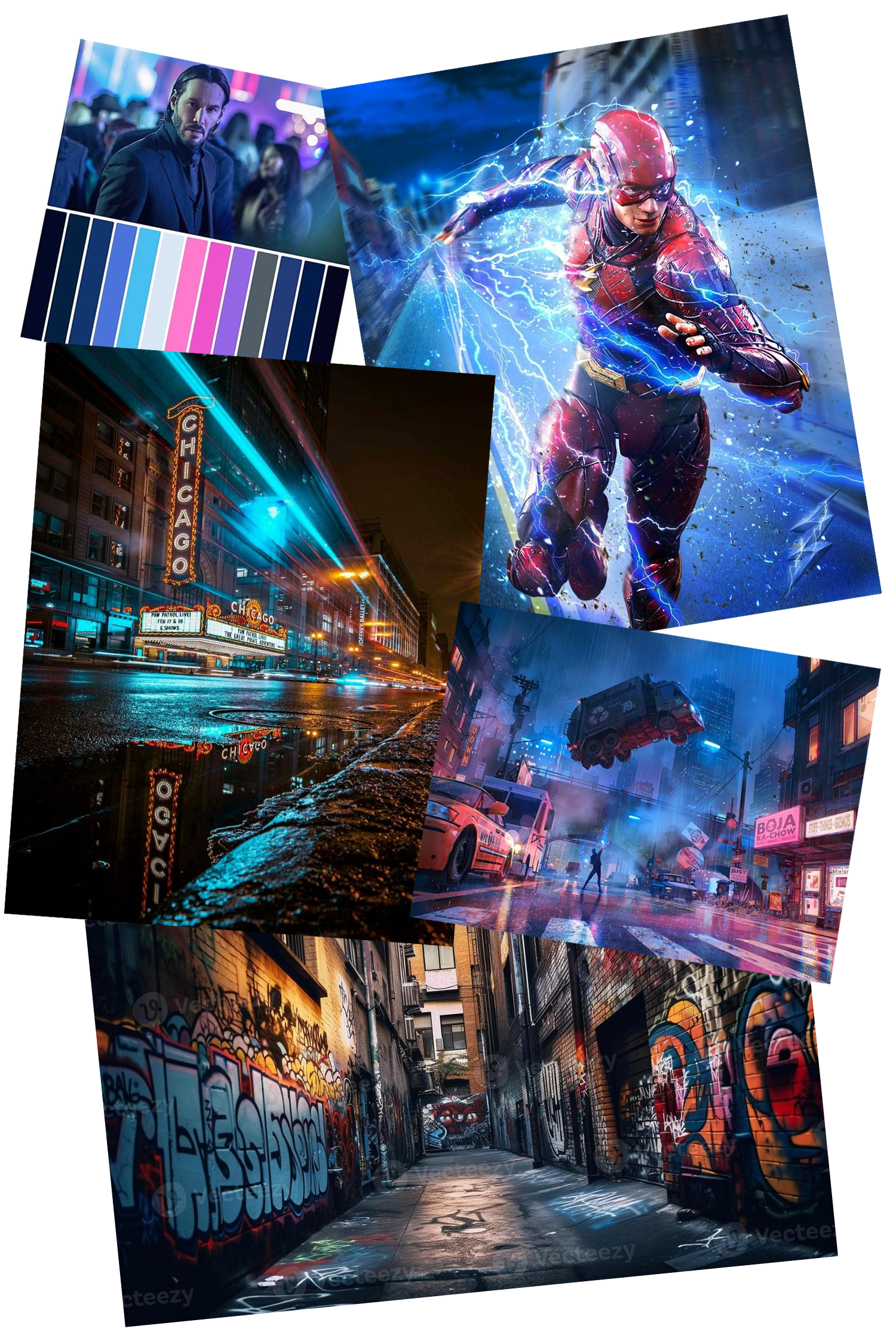
US/EU
Title: Power Leap
Tagline: "Step into the surge."
Overall vibe: Intense, cinematic, powerful
Keywords: Self-expression, heroic energy, individual release
Aesthetic system:
Color: High contrast, red / black / electric blue
Lighting: Cinematic, strong shadows
Pacing: Slow to fast, beat drop
Visual language: Superhero, street realism
Effects: Energy bursts, time freeze, fast camera moves
Core narrative: The sneaker = the moment you step into the surge — the heroic version of yourself, in motion.
-
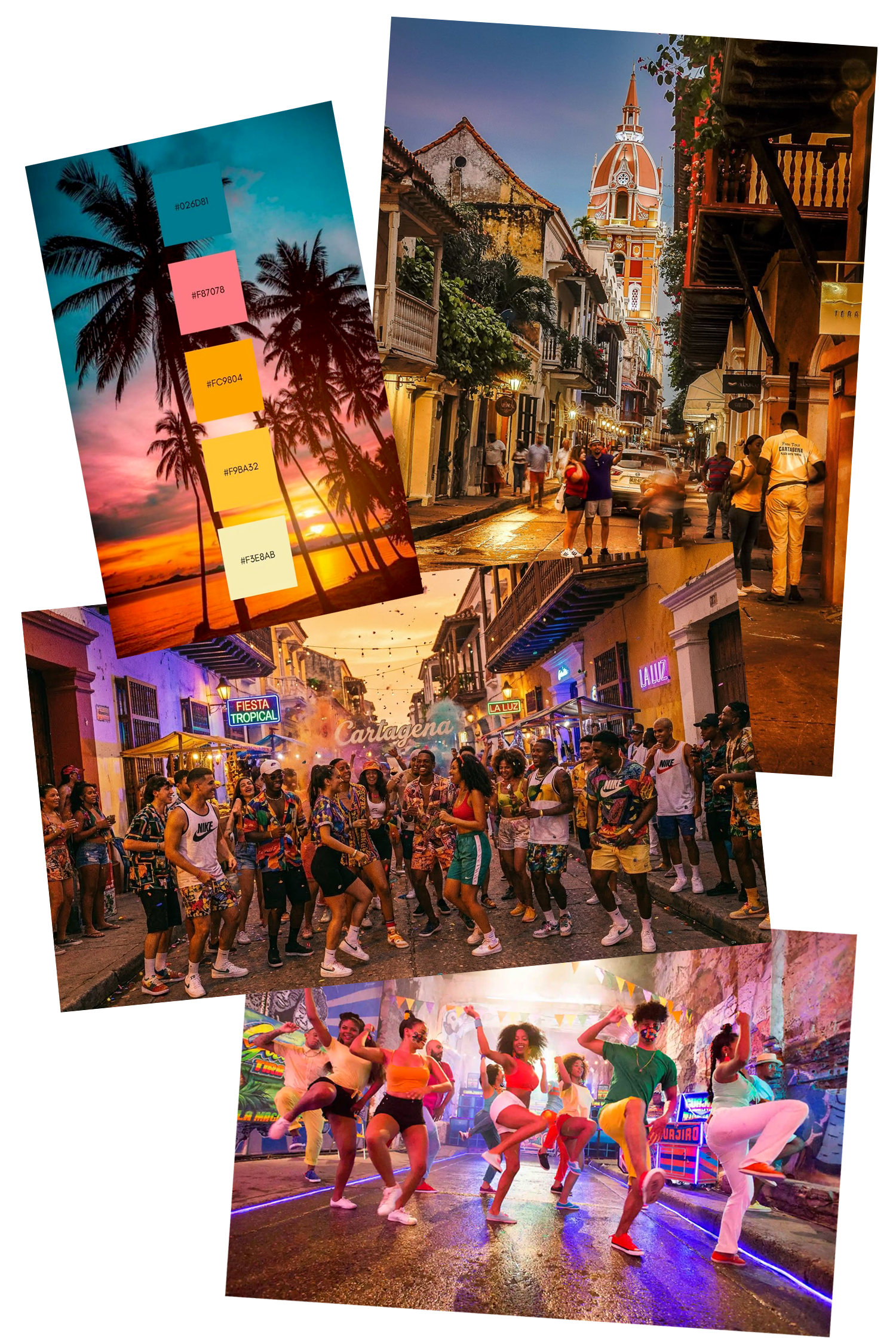
LATAM
Title: ¡Calle Beat!
Tagline: "Feel the beat. Own the street."
Overall vibe: Warm, sensual, celebratory, nightlife
Keywords: Dance, social, confidence, freedom
Aesthetic system:
Color: Warm coral, sunset orange, gold, bright pink
Lighting: Golden hour, club lights, neon reflections
Pacing: Strong rhythmic feel, dance-driven
Visual language: Nightlife, body rhythm, street carnival
Effects: Light halos, motion blur, beat-synced edits
Core narrative: The sneaker carries the rhythm of the street. Feel the beat. Own the street.
Step 5: Seller Reviews the Creative Brief & Generates Videos
Framework layers: Style + Ceiling for prompt design, with Floor running in the background.
This is the seller's primary creative review surface. The seller sees a unified Creative Brief per region containing the Hero frame, Treatment, Storyboard, and Output Settings, all generated from their Step 1 inputs plus the regional creative direction from Step 4.
Every AI-generated default is overridable: the seller can edit any prompt inline, regenerate any scene's reference frame, or promote any reference frame to Hero with a tap. When ready, they commit credits and trigger video generation.
-
Hero frame
The key image representing each video's overall direction
Tap to open fullscreen storyboard viewer; promote any reference frame to Hero
Treatment
The cinematic concept, music style, pacing, and reference notes
Edit inline; regenerate (🪙 25)
Storyboard
Five scenes, each with per-scene reference frames
Tap any scene to view fullscreen; regenerate per-image (🪙 15)
Output Settings
Duration, aspect ratio, quality, variation count, and a real-time generation cost calculation
Tap any setting to cycle through options; cost updates in real time
-
Vertical 9:16 | 30-second standard duration | TikTok Shop commerce content. Built for fast-paced product showcase videos, ~6-8 seconds per scene, tight pacing, strong visual impact.
Scene 1. Product hook. Capture attention in 3 seconds, establish visual anchor. Product close-up, atmospheric setup. Strong visual elements: lighting, texture, dynamic detail. Mood baseline established, brand tone implied.
Scene 2. Motion and transformation. Create visual surprise, lift retention. Product undergoes dynamic transformation or visual effect. Pacing intensifies, syncs with music. Technical capability showcase: particles, light effects, morphing.
Scene 3. Lifestyle or fantasy scene. Build emotional connection, embed usage context. Product integrated into idealized lifestyle scene. Model or creator featured, demonstrates product in use. Audience identification, stylized scene design.
Scene 4. Peak effect moment. Emotional peak, strongest visual memory point. Full-piece visual climax, highest-impact frame. Peak effect density, fastest pacing. Synced with music drop, creates memory anchor.
Scene 5. Brand and product payoff. Brand reinforcement, conversion CTA. Product hero shot, clearly displayed. Brand logo reveal, price or promotion. CTA guidance: click to buy, follow the shop. Loops back to Scene 1 via VFX transition.
-
Each scene in the storyboard has one or more AI-generated reference frames that lock the visual style for that scene.
Most scenes have one reference image; some have two when the scene is visually complex (LATAM Scene 2, the Street Carnival Pan, has two reference frames showing the camera panning across multiple groups of dancers).
One frame across the storyboard is designated the Hero frame: the key image representing the video's overall direction. It's a marker the seller can move: any scene's reference image can be promoted to Hero with a tap.
-
Two product features to build user’s Trust:
Provenance:
A short note above the Generate CTA button reaffirms this provenance explicitly: "Above is the AI-generated creative brief based on [N source files from Step 1]."
The source-file count is a clickable link that jumps back to Step 1, giving sellers a one-tap path to verify what the AI consumed.
Costs Transperancy:
The credit cost ladder is visible at every iteration point:
Regenerate scene reference image. 🪙 15. Per image, in the storyboard fullscreen view.
Make Hero. Free. Designate any scene's image as the Hero.
Regenerate brief content. 🪙 25. Treatment, vibe, or tags.
Apply AI fix (Step 6). 🪙 30. One-tap AI repair suggestion.
Refine (Step 6). 🪙 60. Targeted partial regeneration.
Generate video. 🪙 120 × regions × variations. Full video render.
Variations (3-5×). Multiplies generation cost. Set in the Output Settings card.
Each iteration moment shows its cost honestly. The seller is never surprised by what they spend.
-
Tap Hero frame. Opens the fullscreen storyboard viewer for that region.
Edit any prompt. Inline text editing of any scene, treatment, or technical note.
Regenerate per-image. In the fullscreen viewer, regenerate any specific reference frame.
Make Hero. Promote any scene's image to be the Hero frame for that region.
Generate Video. Commit credits and render the videos.
This demo scenario: The seller reviews all three Creative Briefs, makes no edits (accepts AI recommendations), keeps all three regions selected with 1× variation each, and clicks Generate Video. The system commits 🪙 360 (120 × 3 regions × 1 variation) and proceeds to Step 6.
AI system response
Creative briefs assembled for 3 regions. Treatments, storyboards, and Hero frames generated from seller’s inputs plus regional creative direction. Estimate video generation cost with variation. Approve to generate, or edit any element.
A note on screens vs. stages.
In the prototype, the seller experiences Steps 6, 7, and 8 as one consolidated Results screen: scoring, the background publish-Floor check, and ship actions all in one place.
The conceptual separation in this doc reflects the underlying architecture (the workflow diagram has eight distinct stages).
The UX consolidation reflects what's actually useful for sellers: one screen to review, iterate, and ship from.
Step 6: Seller Reviews Generated Videos with Performance Scores
Framework layers: Ceiling (predicted performance evaluation) + Style (style match scoring).
The system delivers generated videos for each region, scored against Ceiling benchmarks. The seller sees a clean Results view with side-by-side regional comparison: a Performance Score per region (predicted, AI-generated, labeled with an AI PREDICTED provenance pill) and a Style Match score showing how well the output matches the regional aesthetic baseline.
The scores are honestly framed as predictions, never as measured outcomes. If the seller wants to improve any region's output, four iteration paths are available, each with transparent cost matched to compute (Apply Fix, Refine, Regenerate, Variations).
-
If the seller wants to improve any region's output, four iteration paths are available, each with honest cost transparency:
Apply Fix. 🪙 30. One-tap AI repair of the specific issue flagged (e.g., "weak first 3 seconds").
Refine. 🪙 60. Targeted partial regeneration of specific scenes.
Regenerate video. 🪙 120. Full re-render of that region's video.
Generate Variations. 🪙 300 (3×). Produce 3 stylistic variants for A/B testing.
The cost ladder maps to compute: cheap small fixes scale up to expensive full regenerations. The seller chooses how aggressively to iterate.
AI system response
3 videos generated and scored. Performance Scores are predictions based on regional engagement benchmarks.
Scores indicate how the AI predicts each video will perform against top-converting content in its market. Lower scores or flagged metrics suggest opportunities to iterate before publishing. Ready for review.
APAC
US/EU
LATAM
| Metric | Score | Benchmark | Status | How it's derived |
|---|---|---|---|---|
| Performance Score | 87/100 | Top 15% | ✅ Excellent | Composite of below metrics, weighted against top-converting APAC streetwear content |
| Predicted 3-second completion | 82% | ≥85% | ⚠️ Slightly below target | Visual saliency of opening frames vs. high-retention APAC anime/cyberpunk hooks |
| Predicted full completion | 52% | ≥45% | ✅ Above target | Pacing density vs. fast-cut, beat-driven APAC short-form videos |
| Predicted CTR | 3.8% | Category avg 3.2% | ✅ Strong | Hero product framing vs. APAC sneaker conversion patterns |
| Style Match | 94% | Format + aesthetic alignment | ✅ Excellent | Embedding similarity to top 5% APAC cyberpunk-aesthetic content |
Consider strengthening immediate product visibility in the first 3 seconds.
| Metric | Score | Benchmark | Status | How it's derived |
|---|---|---|---|---|
| Performance Score | 91/100 | Top 8% | ✅ Excellent | Composite of below metrics, weighted against top-converting Western cinematic ad content |
| Predicted 3-second completion | 78% | ≥75% | ✅ Above target | Opening dramatic tension vs. high-retention US/EU cinematic-hero hooks |
| Predicted full completion | 61% | ≥55% | ✅ Strong | Narrative arc strength vs. Western slow-build commercial content |
| Predicted CTR | 4.1% | Category avg 3.5% | ✅ Excellent | Hero product reveal timing vs. US/EU sneaker conversion patterns |
| Style Match | 96% | Cinematic narrative alignment | ✅ Excellent | Embedding similarity to top 5% US/EU cinematic-superhero content |
Predicted performance is strong. Ready to publish.
| Metric | Score | Benchmark | Status | How it's derived |
|---|---|---|---|---|
| Performance Score | 89/100 | Top 10% | ✅ Excellent | Composite of below metrics, weighted against top-converting LATAM dance/street content |
| Predicted 3-second completion | 88% | ≥80% | ✅ Excellent | Opening rhythm/energy vs. high-retention LATAM dance-driven hooks |
| Predicted full completion | 44% | ≥40% | ✅ Above target | Beat-synchronization and crowd-energy density vs. LATAM nightlife content |
| Predicted CTR | 4.5% | Category avg 3.0% | ✅ Excellent | Product visibility in dance scenes vs. LATAM sneaker conversion patterns |
| Style Match | 92% | High-energy + dopamine alignment | ✅ Strong | Embedding similarity to top 5% LATAM carnival/reggaeton-aesthetic content |
Opening hook performance is excellent. Consider extending 2-3 seconds to improve full completion rate.
Step 7: Publish Check (Background)
Framework layers: Floor (output-side validation).
Before any video can be published to TikTok Shop, the system runs an output-side Floor check. Like the input-side check at Step 2, this runs invisibly unless something fails. Well-functioning Floor is invisible by definition.
Output Floor catches non-compliant content (warped logos, prohibited imagery, illegible AI-generated text, regional marketing-language violations) before it ever reaches the platform. invisibly unless something fails.
Output-side Floor coverage
| Check | What it validates |
|---|---|
| Generated content safety | No prohibited imagery, no policy violations |
| Brand mark integrity | Logo not warped, distorted, or obscured by AI artifacts |
| Text clarity | Generated text legible (catches common AI text-warping issues) |
| Regional compliance (APAC) | No prohibited marketing language for target markets |
| Regional compliance (US/EU) | No FDA-restricted language, no false claims |
| Regional compliance (LATAM) | Meets ANVISA standards, regional ad compliance |
| Platform compliance | TikTok Shop ad policy, content guidelines |
-
Floor checks at two points in the flow is a deliberate framework decision.
Input Floor (Step 2) prevents wasted compute on bad source material.
Output Floor (Step 7) prevents non-compliant content from reaching the platform.
Both are invisible to the seller by design- Floor is the framework's "must-pass" layer, and well-functioning Floor is invisible by definition.
AI system response
All checks passed. Ready to publish.
(If failure:) > One or more issues need fixing before publishing. We've flagged what to address.
Step 8: Seller Publishes, Saves, or Edits
Framework layers: All three layers complete. Floor green-lit. Ceiling scored. Style locked.
The final commit step. The seller has reviewed videos, seen Performance Scores, and decided to ship. The Push to Shop button wears TikTok red, the system's primary commit color, reserved for truly irreversible high-stakes actions. Every other action in the flow uses secondary styling: when a seller sees red, the action is committal.
-
☑️ Download all versions (MP4, 1080p)
☑️ Push directly to TikTok Shop ad campaigns
☑️ Schedule publish (optimized by regional time zones)
☑️ Save to library for future reuse or remixing
Calibration and Bias: What This Demo Doesn't Show
The demo above presents the framework working. Two things production-grade behavior design would include but this demo doesn't: calibration data showing rubrics can be applied consistently across raters, and bias audit showing where the framework's assumptions might systematically fail specific groups. Both are core to AI Behavior Design as a discipline. Surfacing them honestly is part of the work.
Calibration
Calibration is how the framework proves the Performance Scores mean the same thing across different reviewers.
Without it, a score of 87/100 could mean "excellent" to one rater and "merely OK" to another, and the framework would be unable to tell the difference between a real quality issue and rater disagreement.
The Performance Scores shown in this demo are system-generated illustrative outputs, not human-calibrated benchmarks. A real production rollout would replace those scores with calibrated rater consensus before launch.
The cross-regional case adds a structural complication on top of standard calibration: raters within a region tend to agree with each other more than raters agree across regions, which can mask real quality differences behind regional baseline drift.
-
3 to 5 raters per region scoring the same set of generated videos
Inter-rater reliability (Cohen's kappa) target greater than 0.7
Disagreement analysis identifying which criteria are subjective vs. observable
Recalibration cycles when kappa drops below threshold
Per-criterion variance reporting (different Ceiling sub-scores may calibrate at different rates)
-
Raters within a region tend to agree with each other more than raters across regions.
Regional baseline drift can mask real quality differences.
Production rubrics handle this through stratified calibration: per-region kappa measured separately, with a meta-check on inter-regional consistency.
A 0.85 within-APAC agreement paired with 0.50 cross-regional agreement reveals a structural issue the framework needs to address, not a rater problem.
Bias surfacing
The three regional creative directions (Neon Bloom for APAC, Power Leap for US/EU, ¡Calle Beat! for LATAM) encode aesthetic stereotypes.
The AI generated these by extracting top-performing patterns from existing content, but existing content reflects existing biases. APAC is not only anime cyberpunk. LATAM is not only street carnival nightlife. These are subgenre stereotypes amplified by what previously converted on TikTok, and the framework as written treats high-converting subgenres as regional defaults.
A production version of this framework would need to honestly answer three diagnostic questions: who decided what each region looks like, who gets excluded by those defaults, and what recourse exists for creators outside the dominant pattern.
None of those answers ship with this demo. They're known gaps a production rollout would need to address before scaling.
-
The regional aesthetics here were generated by AI extracting top-performing patterns from existing content. But existing content reflects existing biases.
APAC is not anime cyberpunk. LATAM is not street carnival nightlife. These are subgenre stereotypes amplified by what previously converted on TikTok.
The framework as written treats high-converting subgenres as regional defaults, which means the decider is the historical conversion data, not a deliberate cultural review.
-
APAC contains hundreds of millions of people for whom "anime cyberpunk" is not their aesthetic register.
LATAM creators making documentary work or quiet lifestyle content would be miscategorized.
Older buyers in any region would be invisible to a framework trained on Gen Z conversion patterns.
The framework rewards conformity to the highest-converting subgenre per region, which means it systematically scores creators outside that subgenre lower.
-
A production version would need:
A way for creators to opt out of the dominant regional pattern
A meta-rubric tracking which demographic groups the framework systematically scores lower
Periodic audit cycles where the "top 5%" reference set is interrogated for representation
Style dimension that can hold multiple valid configurations per region rather than one default.
-
The framework can scale across regions.
But scaling aesthetic patterns without scaling aesthetic pluralism is how regional bias gets encoded into AI quality systems.
A real Floor / Ceiling / Style for cross-regional video would treat regional aesthetic as a Style dimension with multiple valid configurations per region, not one default per region.
Calibration data and bias audits are the operational practice that catches this. Both belong in the production version of the framework, even if neither shipped with the demo.
AIGC Video Generation: Core Challenges and Solutions
The demo above shows the framework working in product flow. But producing it surfaced what current AIGC tools can and cannot do. The following four tables document the real challenges and how they map to product, UX, and operational solutions.
*Documented in December, 2025
| Challenge | Root cause | Solution | Status |
|---|---|---|---|
| Visual consistency | Product shape, logo, character faces, and materials drift between frames. The model lacks object permanence. | Image-conditioned generation using Hero frame references. Limit clip length to 2-4 seconds. Use a references system across scenes. | ⚠️ Technical limit |
| Temporal stability | Quality degrades after 5-10 seconds. Camera motion and causal logic drift over time. | Limit to short clips. Constrain camera to locked-off or slow dolly. Build narrative through editing. | ⚠️ Improving |
| Physics and interaction | Holding products, physical contact, and causal sequences fail to look real. The model lacks physical world understanding. | Avoid direct interaction. Use cutaways, match cuts, near-contact illusions. | ❌ Unsolved |
| Text and brand safety | The model hallucinates gibberish letters and warps logos beyond recognition. Any frame attempting to show product names, taglines, or brand marks is unreliable. Lighting and reflections shift unpredictably. | Generate without on-screen text or logos. Composite brand marks, product names, and taglines in post-production using After Effects, CapCut, or a dedicated post-pipeline. Treat text overlay as an editing layer, never as something the model generates. | ❌ Unsolved |
| Audio-video sync | Most models can't generate synced audio. Lip-sync still requires a separate workflow. | Use dedicated audio tools. Sync during edit and post. | ⚠️ Emerging area |
| Challenge | Root cause | Solution | Status |
|---|---|---|---|
| Asset dependency | High consistency requires a structured reference image set across multiple angles and lighting conditions. | Build a standardized asset library per product and character. Define shot type templates. | ⚠️ Operational cost |
| Prompt and clip orchestration | A single prompt can't maintain creative intent. Engineering needs to manage many fragmented clips. | System automatically breaks the story into shot-level prompts. Treat AI video as modular blocks. | ✅ Product-solvable |
| Non-deterministic output | The same prompt + image produces unstable results. Single-take generation isn't guaranteed. | Generate in batches (3-5 variants). Expect a hit rate, not certainty. Add review workflows. | ⚠️ Model nature |
| Latency and cost | Generation is slow and expensive. | Generate image previews first (Hero frame + per-scene references). Use the full model only for finals. Per-image regeneration (🪙 15) keeps iteration affordable. | ⚠️ Improving |
| Challenge | Root cause | Solution | Status |
|---|---|---|---|
| Control vs automation tradeoff | More automation means less creative control. More control means more complexity. | Use templates, presets, and constrained creative systems with progressive disclosure. Hero frame + per-scene references give sellers granular control without overwhelming them. | ✅ Product design |
| Editing as core value | AI outputs clips, not finished narratives. Raw material needs assembly. | Treat AI video as raw material. Embed edit logic (cuts, pacing, sequencing) into the product. | ✅ Opportunity |
| Cost transparency | AI generation feels like a black box of compute. Sellers don't know what each action costs. | Show credit costs at every iteration point. Bind costs to selections (per market, per variation). Reserve commit colors (red) only for truly irreversible high-cost actions. | ✅ Product design |
| User expectation gap | Users expect: one prompt → perfect cinematic video. | Set expectations through UX: short clips, modular blocks, edit-first workflow. Reveal complexity progressively. | ✅ UX-solvable |
| AI provenance trust | Sellers don't know whether the AI made things up or used their inputs. | Thread provenance pills (AI SUGGESTED / AI CURATED / AI PREDICTED) through every AI output. Show source-file references inline at commit points. | ✅ AI Behavior Design |
| Challenge | Root cause | Solution | Status |
|---|---|---|---|
| Regional compliance | APAC, US/EU, LATAM each have different content restrictions, prohibited marketing language, and regulatory requirements. | Embed compliance validation into both Floor checks (input and output). Regional rule engines flag automatically. | ✅ Product-solvable |
| Localization at scale | The same product needs different aesthetics, pacing, and cultural symbols across markets. | Regional style presets. Automated A/B testing. Localization built into the prompt layer. Each region carries its own creative direction with distinct vocabulary (Neon Bloom / Power Leap / ¡Calle Beat!) and tagline structure. | ✅ Product-solvable |
| Product demo realism | AI-generated product-in-use scenes lack tactile realism. Hands-on demos look unnatural. | Focus on lifestyle and atmospheric shots. Use real footage for hand-interaction moments. | ⚠️ Scene-limited |
| UGC vs AIGC perception gap | Platforms automatically label AIGC content with C2PA watermarks. This affects authenticity and trust signals. | Mix AIGC with real footage. Label transparently. Use AIGC as supporting content, not headline content. | ⚠️ Policy evolving |
Closing
AIGC video generation sits at a critical intersection of technical capability and business value. The current technical challenges are real, but each limit also contains a product innovation and experience design opportunity. The promise is concrete: every seller, regardless of budget or production resources, can produce content that moves users and drives GMV at a fraction of the cost and time.
The design discipline is what determines whether those limits become friction or differentiation. This is AI Behavior Design at the product layer: not a workaround for AI's current ceiling, but how the ceiling gets raised in the meantime.
With love and peace,
Kenneth
Continue to Part 4
Continue to Part 4, which applies the same framework to a different use case: making AI-generated content feel like authentic human creation.