
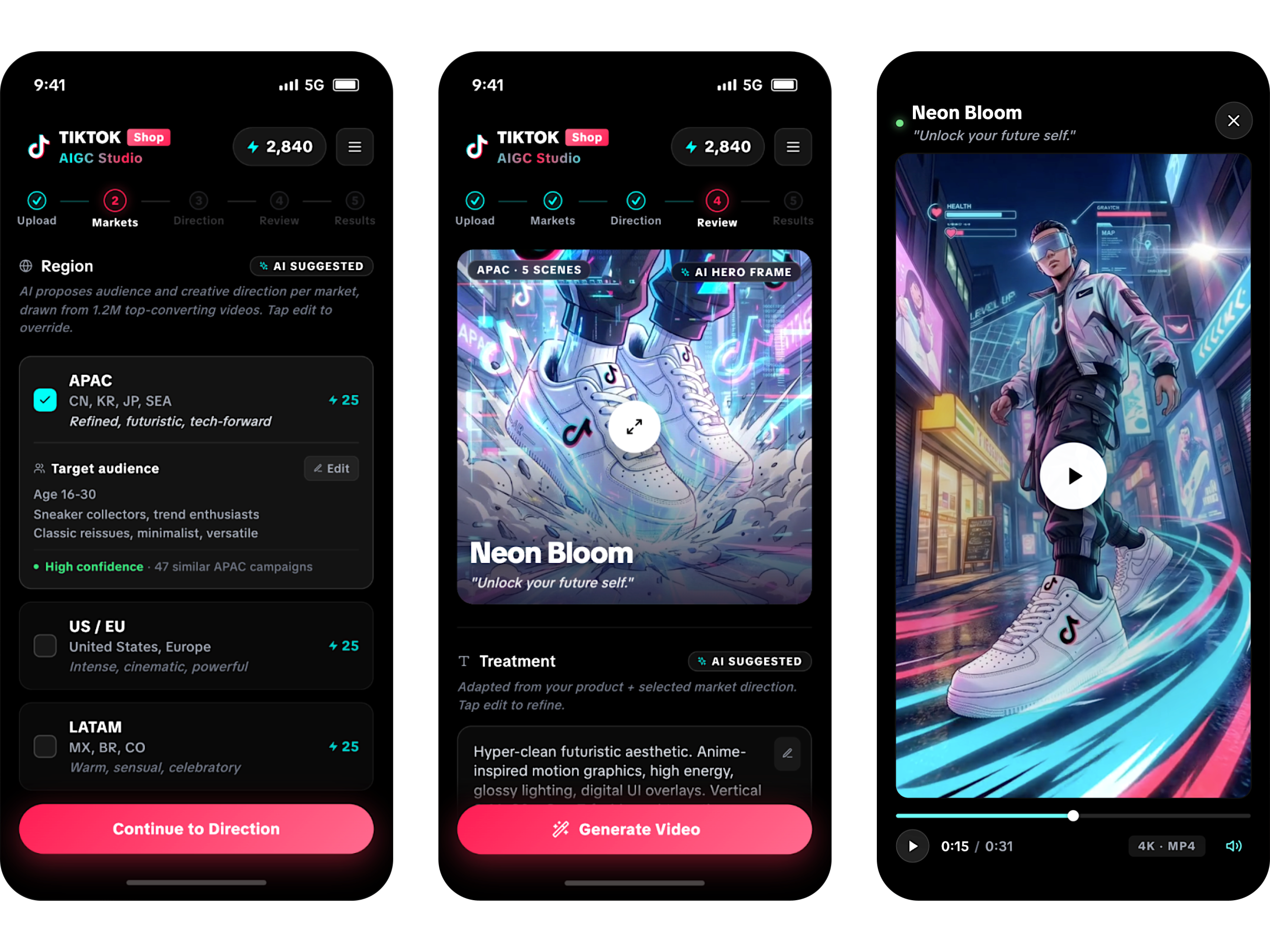
Designing AI Quality Systems for AI-Generated Commerce Video
A four-part case study asking: How do we ensure AI-generated video quality for social media commerce?
Using TikTok Shop as a test case, the exploration proposes a three-layer quality framework: Floor (binary safety gate), Ceiling (numeric optimization target), Style (categorical contextual fit). The framework is designed to surface bias, build user trust, and target GMV lift.
The case studies show what AI Behavior Design could look like as a practice. They cover four things: setting safety thresholds that adapt to different content categories, defining quality by benchmarking against the work already performing well, breaking style into specific attributes a model can recognize, and turning human judgment into signals an AI system can actually learn from.
The result is design exploration of an emerging discipline that sits at the intersection of policy, product, data, and ML engineering.
Amor Fati:
Stress-Testing Google Flow by Breaking It on Purpose
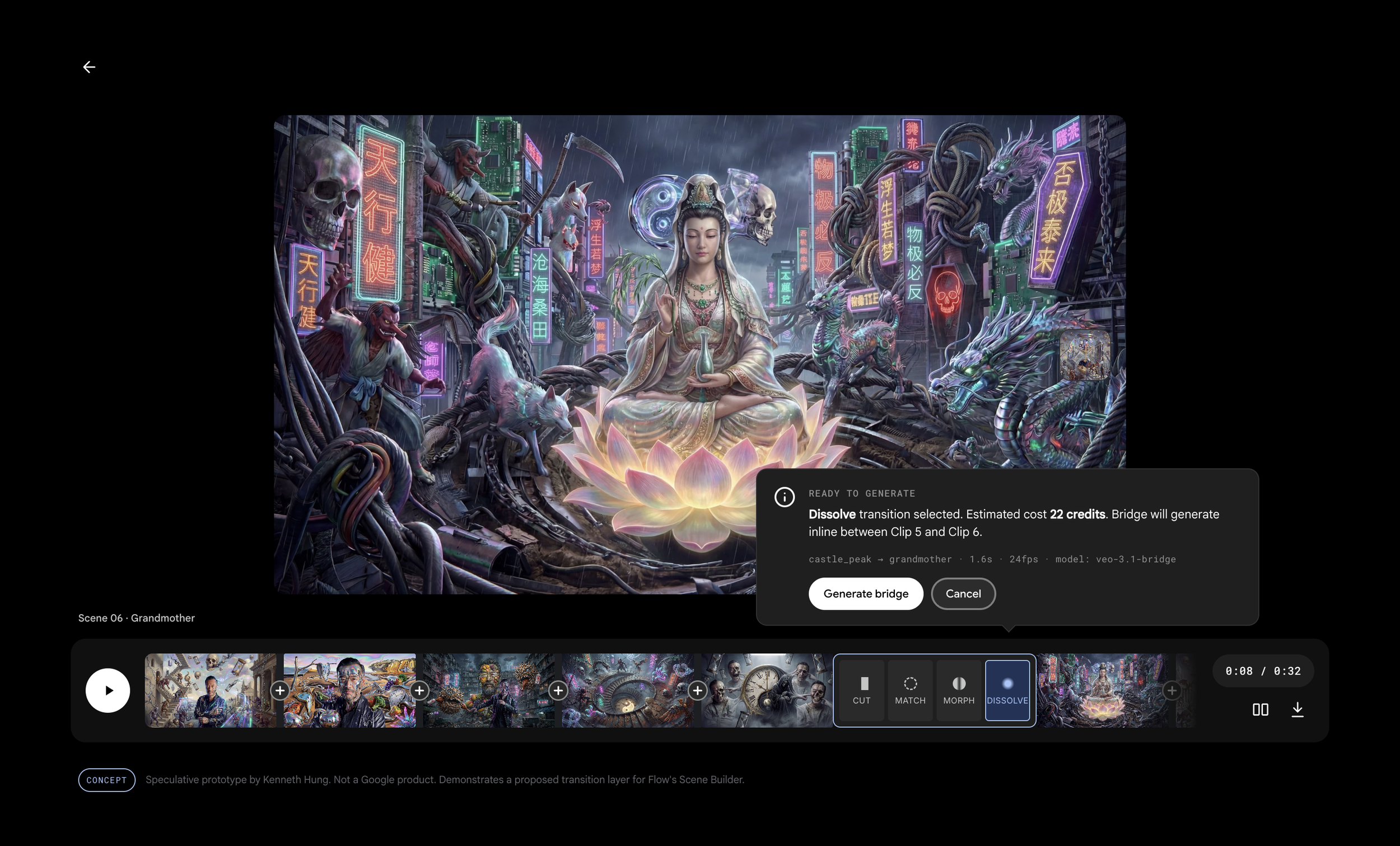
A surreal short generated entirely through Google Flow, using one photo (my LinkedIn profile) as the only identity reference across wildly different aesthetics: cyberpunk, classical meets sci-fi, horror, video game.
The project probes system limits: identity drift, anatomical inconsistency, interpolation breakdowns, export artifacts, and UX friction at scale. Rather than optimizing for output, the work surfaces design insights for professional AI video workflows.
The result is both a personal narrative and a product-level case study in how AI video evolves from clip generator to creative infrastructure.
Designing Intelligence:
UX in the Age of AI
My ongoing exploration of what UX must become in the age of AI. After a year immersed in AI products, I'm convinced this isn't just an interface evolution. It's the most fundamental shift in human-computer interaction since the GUI.
This deck maps that territory: six core pillars of AI UX, design approaches across Assistant, Domain Expert, and Agentic AI systems, and a reframing of success from efficiency to relationships, with live prototypes that make each idea tangible.
Part provocation, part framework, part personal manifesto. Built from 15+ years of experience and a belief that UX designers who evolve now will shape how intelligence becomes humane.

AI Behavior Design
Screens, flows, buttons. For decades, that was the job. AI changes the premise entirely. Users don't navigate systems anymore; they state intent. And the system responds: probabilistically, creatively, sometimes unpredictably.
Which means the new design surface isn't UI. It's behavior. How a system interprets intent, balances creativity against reliability, maintains tone and continuity, and builds trust across interactions, not just within one.
This piece makes the case for AI Behavior Design as an emerging discipline, and what it demands from designers who are ready to work at the level of intelligent systems rather than screens.
Designing Binance for 300M people
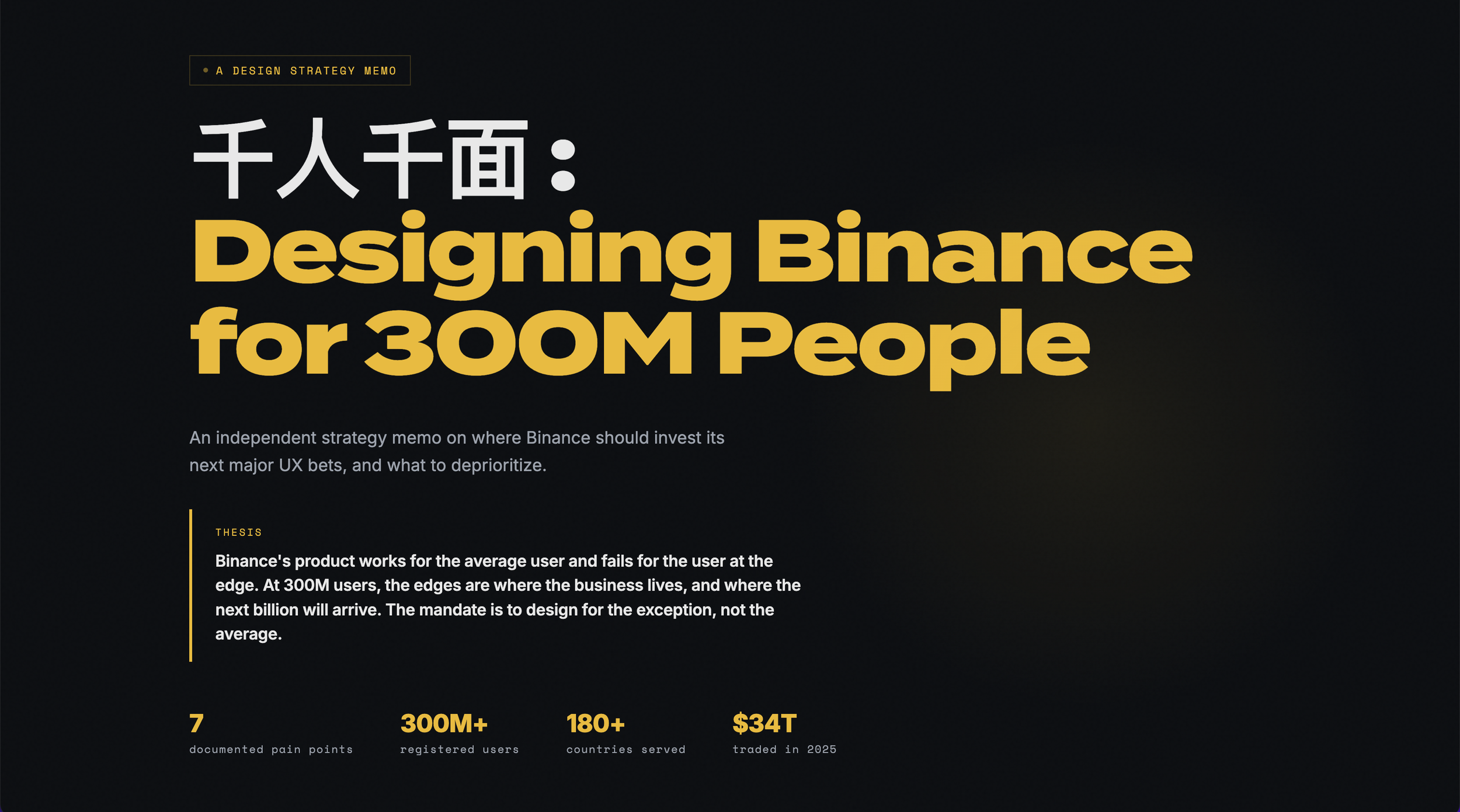
A strategic design memo on where Binance, the world's largest crypto exchange serving 300M+ users, should invest its next major UX bets and what to deprioritize. Most American product designers have never opened it. Binance.US is a stripped-down shadow of the global product, and the 2023 DOJ settlement pushed the platform out of US consciousness. Outside the US, Binance moves $34T annually and shapes how billions in emerging markets touch finance.
This memo follows companion UX research that surfaced seven pain points across the platform. Here, I take a position: force-ranking them into three to fix in 2026 and four to deliberately deprioritize, then laying out a three-year vision across five pillars, anchored in the Chinese design philosophy 千人千面 ("one thousand people, one thousand faces").
A strategy that doesn't say no isn't a strategy. Claude was the research collaborator. Human judgment owned the framing and every call about what to leave out.