


Part I:
The Awakening
Recognizing the moment when everything changes
For 60 years, human-computer interaction was command-based. You told the machine what to do: click, type, select, execute. AI changes everything. For the first time in computing history, machines interpret human intent rather than execute commands, and that shift demands an entirely new UX foundation. This section makes the case for why this moment is different, and why the old playbook no longer applies.


Part II:
The Evolution
How we got here, and why the past no longer guides us
UX has evolved through three distinct eras, and each one required designers to fundamentally reinvent their practice. But the leap into AI isn't just another evolution. Some principles endure. Some become obsolete. And some are born entirely new. This section maps what to keep, what to abandon, and introduces the 6 Pillars of AI UX, the new foundation for designing intelligent experiences.


Part III:
The Practice
How to design when the system thinks back
Knowing AI requires new principles is one thing. Knowing how to actually design for it is another. This section gets practical, breaking down the design process, mental models, and specific priorities for three fundamentally different AI archetypes: General LLMs, Specialized LLMs, and Agentic AI. Each one requires a different approach, different guardrails, and a different definition of success. Explore the live prototypes to see each principle in action.


Designing for Different AI Archetypes
A UX Framework for the Age of Agentic AI
Four interactive prototypes exploring how UX principles change as AI systems grow more autonomous. From conversational assistants to enterprise workflow orchestration, each prototype isolates a different design problem, demonstrates a working solution, and explains the reasoning behind every decision.
-

AI Assistants
Chat AI Assistant generates infinite answers, and infinite confusion. The UX must guide the conversation intelligently, not control it rigidly.
AI UX design principles:
● Scaffolding Ambiguity
● Memory Transparency
● Trust-by-Design
● Conversational Explainability
● Error Transparency & Repair -

Domain Expert AI
Domain Expert AI aren't general thinkers. They're domain partners. Their UX must prioritize precision over personality, confidence over convenience.
AI UX design principles:
● Domain Guardrails
● Transparent Reasoning Chains
● Contextual Confidence Scores
● Verifiable Citations
● Human Override Options -

Autonomous AI Agents
Agentic AI executes multi-step tasks independently. The UX must balance autonomy with oversight, ensuring transparent delegation, intuitive control.
AI UX design principles:● Verification Before Action
● Undo Mechanisms
● Blame Attribution
● Authority Levels
● Explainability -
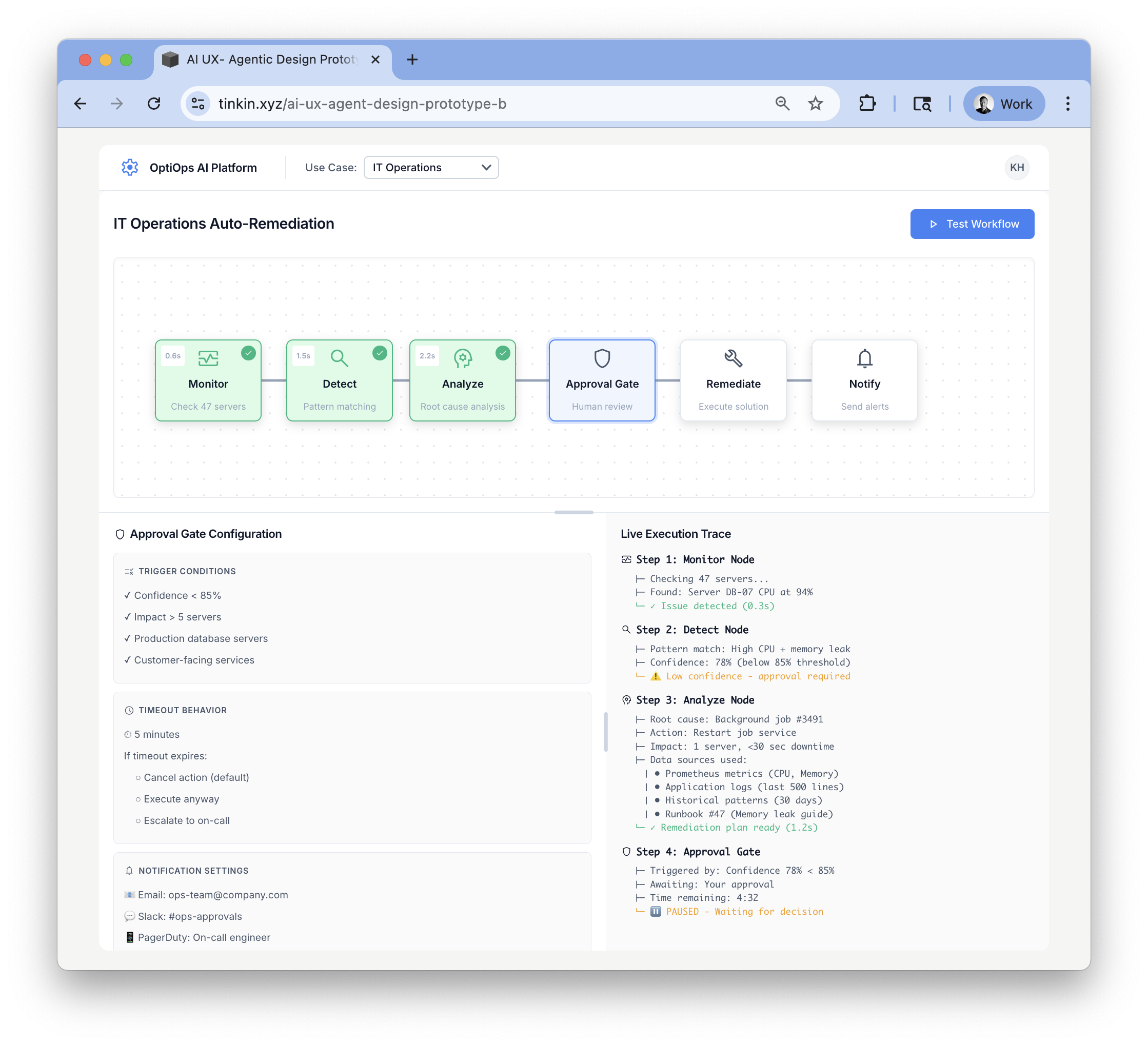
Orchestrated AI Agents
Enterprise AI agents run continuous workflows across entire organizations. The UX must focus on explicit authorization and governance at scale.
AI UX design principles:● Pipeline Visibility
● Human Placement
● Configurable Autonomy
● Audit Transparency
● Framework Portability
Part IV:
The Metrics
Measuring what matters when the interface learns
If you're still measuring clicks, conversions, and task completion, you're measuring the wrong things. AI UX demands a new measurement vocabulary, one that captures how well human and system align, adapt, and grow together over time. This section replaces outdated efficiency metrics with relationship-centered ones: trust score, model alignment, adaptation rate, and co-agency balance.


Part IV:
The Future Vision
The designer's role when intelligence becomes our collaborator
The next decade will bring autonomous agents, ambient wearables, predictive interfaces, physical AI, and eventually AGI. Each wave carries profound UX implications, and most design organizations aren't ready. This section maps the near, medium, and far horizon of AI evolution, and closes with a direct call to action for UX leaders: the window to lead this transformation is open now, but it won't stay open long.


